Wednesday, September 11, 2013

Conjunction Junction.

 An Ongoing Discussion/Moment of Clarity.


words. 

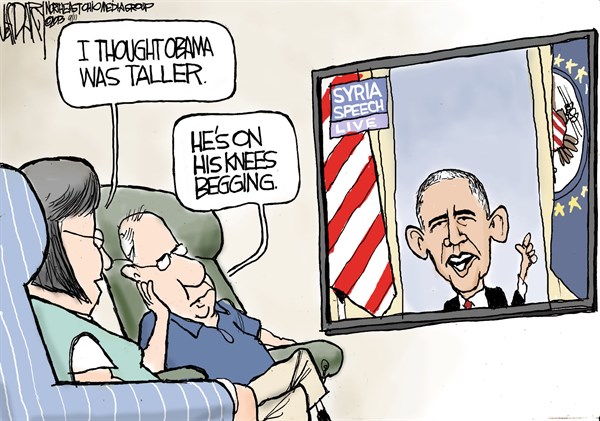
"In the strange period since August 21st, when the poison-gas attacks took place, the White House has seemed incapable of strategic thinking. The State Department seems incapable of coherent communication. Republicans who never raised a question about Iraq are now in full flight from the use of force because they don’t like the Commander-in-Chief. The United Nations can’t bring itself to condemn chemical weapons regardless of who’s using them. Assad’s war crime has turned into Obama’s embarrassment. Everything is upside down; nothing seems to be working as it should.

On Monday, the Times released results of a poll on Syria. Nearly two-thirds of Americans don’t think the United States should involve itself in solving foreign conflicts. For better or worse, we’ve decided that someone else should do this. “We’re pretty good at destroying regimes, but we’re not very good at setting up nations,” a sixty-nine-year-old Virginian named Anne Walsh told the pollsters. “We cannot resolve someone else’s civil war through force,” Obama told the country. That is the legacy of these past twelve years."

THE NEW YORKER: Obama’s Speech: A Cause Already Lost

EARLIER: 

Smooth Operator. 

Monday, September 09, 2013

for your consideration.


THE NEW YORK TIMES: Why Janet Yellen, Not Larry Summers, Should Lead the Fed

Applesauce.

An Ongoing Discussion/Moment of Clarity.

words.

"For most of American history, parents could expect that their children would, on average, be much better educated than they were. But that is no longer true. This development has serious consequences for the economy.

...As the current recovery continues at a snail’s pace, concerns about America’s future growth potential are warranted. Growth in annual average economic output per capita has slowed from the century-long average of 2 percent, to 1.3 percent over the past 25 years, to a mere 0.7 percent over the past decade. As of this summer, per-person output was still lower than it was in late 2007. The gains in income since the 2007-9 Great Recession have flowed overwhelmingly to those at the top, as has been widely noted. Real median family income was lower last year than in 1998.

There are numerous causes of the less-than-satisfying economic growth in America: the retirement of the baby boomers, the withdrawal of working-age men from the labor force, the relentless rise in the inequality of the income distribution and, as I have written about elsewhere, a slowdown in technological innovation. 

Education deserves particular focus because its effects are so long-lasting. Every high school dropout becomes a worker who likely won’t earn much more than minimum wage, at best, for the rest of his or her life. And the problems in our educational system pervade all levels..."

THE NEW YORK TIMES: The Great Stagnation of American Education

piggly wiggly.

A Moment of Clarity.


WORDS.

"In the struggle between capital and labor, capital is winning — and that’s hurting the feeble economic recovery. To simplify slightly: Labor (wage-earners and consumers) can’t spend, and capital (businesses and shareholders) won’t spend. Without a powerful growth engine, the economy advances haltingly.

...Labor’s shrinking share curbs consumer spending. The economy will then falter if the recipients of capital income don’t offset the weakness with increased spending on buildings, equipment, research and new products. Unfortunately, this doesn’t seem to be happening.

Corporate America is husbanding its profits. It invests mainly in the safest projects. From 2007 (the previous business cycle peak) to 2012, domestic corporate profits climbed 35 percent while investment in plants and equipment rose only 2.6 percent. U.S. companies have accumulated a huge cash hoard of $1.8 trillion as of the end of 2012.

A well-functioning economy is a circular process by which one person’s spending becomes another person’s income, which is then spent again. Today, there’s a damaging disconnect between capital’s rising share and its subsequent spending. So the economy sputters.

...The economy seems stuck in a self-defeating cycle: Weak consumer spending rationalizes weak investment spending; this keeps economic growth low and unemployment high, while putting downward pressure on labor’s income share.

We need to break this cycle.

...What would improve the odds is more exuberance from the custodians of capital. CEOs seem content to sit on their profits and invest only when the needs and the returns are indisputable. Careless capital, which fostered the financial crisis, has given way to ultra-cautious capital, which is making a lackluster economy self-fulfilling."

THE WASHINGTON POST: Capitalists wait for the recovery, while labor loses out

Reflektor.

A video.

From Arcade Fire.


free your mind.


PITCHFORK: Cut Copy Announce New Album Free Your Mind, Share Title Track

MONEY.

An Ongoing Discussion...

words.

"It’s easy to forget that cash is costly to access, until you’re paying an A.T.M. fee or spending time riding a bus to a check-cashing window when you could have been working. Now, a study published on Monday morning has quantified the cost of cash, and who gets hit the hardest. The unsurprising answer: low-income people.

...The reason for the difference is that wealthier people and lower-income people tend to access cash differently. Wealthier people are more likely to have bank accounts, which means that they can visit an A.T.M. run by their bank without paying a fee; the same goes for cashing checks. Lower-income people, meanwhile, disproportionately use check-cashing services, which are known for their high add-on charges. Plus, employers have started compensating low-paid, hourly workers with prepaid cards that come with huge fees.

All this matters because it adds up to another way in which lower-income people are at a disadvantage when they can’t, or don’t, access the basic financial services that many wealthier people take for granted..."

THE NEW YORKER: The Cost of Cash, for the Rich and the Poor

royals.


PITCHFORK: Articles Radio-Friendly Unit Shifters: 25 Years of Billboard’s Alternative Music Chart

Evil Eye.

A video.

From Franz Ferdinand.


WHITE WOMEN.


PITCHFORK: Chromeo Announce New Album White Women

Can't Sleep Together.


Starring Miguel.

ROLLING STONE: Miguel Seeks Late-Night Romp in 'Can't Sleep Together' - Song Premiere